


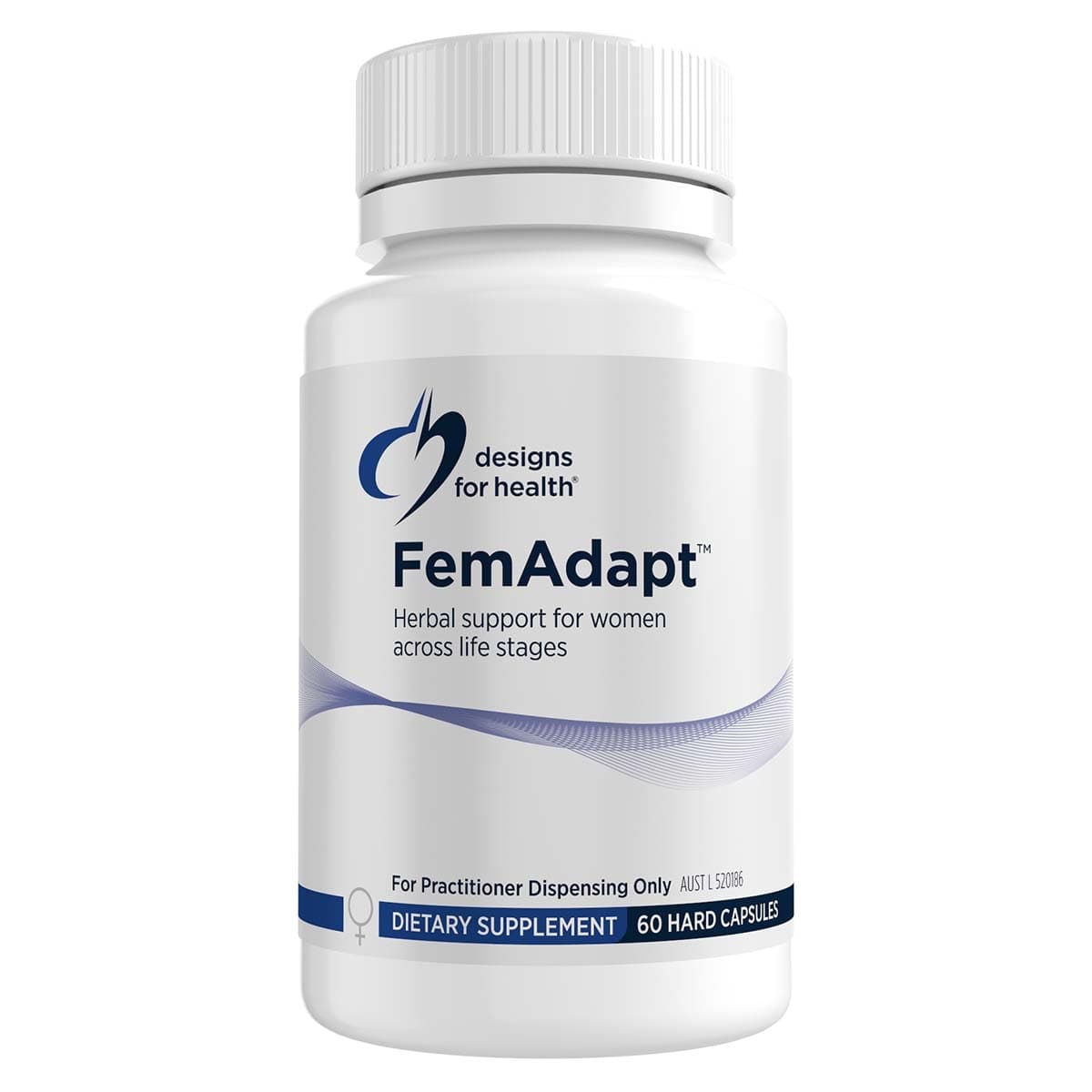
Designs for Health FemAdapt 60 Capsules
Always read the label and follow the directions for use.
Code: 12003540
Collect 58 Everyday Rewards Points*
Choose delivery option
Ways to shop with us
Shop with confidence and enjoy 30 days returns.
Estimate includes item & cart. Excludes bulk shipping.
Product Overview
HPO and HPA Axes
The hypothalamic-pituitary-ovarian (HPO) axis and the hypothalamic-pituitary-adrenal (HPA) axis are central regulatory systems involved in female hormonal function and the stress response.
The HPO axis coordinates ovarian hormone production through signalling between the hypothalamus, pituitary gland, and ovaries, influencing oestrogen and progesterone patterns across the reproductive lifespan. The HPA axis regulates cortisol secretion and plays a key role in circadian rhythm, energy metabolism, and physiological responses to physical and psychological stress.
These two systems are closely interconnected. Chronic or sustained stress can influence ovarian signalling via the hypothalamus and pituitary, while changes in ovarian hormone output can in turn affect stress sensitivity, sleep regulation, and emotional resilience.19 During peri- and post-menopause, fluctuations and eventual declines in ovarian hormone production coincide with increased stress reactivity and altered neurochemical signalling. This interaction helps explain why experiences such as fatigue, sleep disturbance, mild anxiety, vasomotor symptoms, and reduced wellbeing are commonly reported together during hormonal transition.
Traditional systems of medicine have long recognised the relationship between reproductive health, stress adaptation, and overall vitality. In Ayurvedic medicine, certain herbs are classified as adaptogens and female tonics, traditionally used to support the body’s ability to adapt to stress and promote balance during life-stage transitions. In Chinese medicine, herbs have been used traditionally to support menstrual regularity, relieve fatigue, and promote systemic harmony during periods of physiological change.
From a modern herbal medicine perspective, these traditional concepts align with supporting general health and wellbeing, promoting stress adaptation, and maintaining healthy female hormonal balance. Rather than targeting individual symptoms in isolation, this approach recognises the interconnected nature of hormonal and stress physiology during pre, peri- and post-menopause.
Asparagus racemosus (Shatavari)
Shatavari is a botanical native to India and has been used for centuries in traditional systems of medicine including Ayurveda, Unani and Siddha.
Phytochemical analysis of A. racemosus has identified steroidal saponins (shatavarins), along with flavonoids, isoflavones and other polyphenolic compounds.
These constituents are considered characteristic markers for the species and are commonly used for extract standardisation.
Peonia lactiflora (Peony)
Paeonia lactiflora, commonly known as white peony (Bai Shao), is an important herb in the Chinese pharmacopoeia, traditionally using the dried root as the medicinal part. In traditional Chinese medicine (TCM), white peony has been used for centuries in gynaecological formulations and is traditionally used to relieve menstruation pain, particularly where pain is associated with uterine tension, cramping or spasm.
In traditional practice, white peony is commonly combined with other herbs in classical TCM formulas for menstrual pain, where its actions are described as nourishing and harmonising, consistent with its long standing use in women’s health.
Phytochemical analysis of P. lactiflora root identifies paeoniflorin, a monoterpene glycoside, as the primary characteristic constituent, alongside related glycosides and phenolic compounds.1,5 Paeoniflorin is widely used as a marker compound for extract standardisation, reflecting both the identity and quality of peony root preparations.
Rehmannia glutinosa (Rehmannia)
Rehmannia glutinosa is a traditional Chinese herb in which the root is the medicinal part. In FemAdapt, prepared/cooked rehmannia is used (known in TCM as Shu Di Huang), which is produced by processing the clean fresh root through repeated steaming and drying.
This processing alters the herb’s traditional energetics and clinical emphasis compared with the uncured form. In TCM, the prepared form (Shu Di Huang) is considered more nourishing and restorative, whereas the raw form (Sheng Di Huang) is described as cooling and clearing in nature.
Prepared rehmannia is traditionally used in TCM to relieve menstrual cycle irregularity, to reduce heavy menstruation, and to relieve fatigue. Phytochemically, rehmannia root contains iridoid glycosides, including catalpol and rehmanniosides, which are commonly referenced as characteristic constituents and used in the quality and identity assessment of prepared rehmannia extracts.
Scutellaria laterif lora (Skullcap)
Scutellaria lateriflora, commonly known as skullcap, is a North American herb traditionally prepared from the aerial parts, including the leaves and flowering tops. Skullcap contains a range of flavonoids, including baicalin, baicalein, scutellarin and wogonin, which are considered characteristic constituents of the species.
In modern herbal practice, skullcap is valued for its compatibility with other botanicals and is frequently incorporated into multi-herb formulas intended for use during periods of physiological change, where a gentle, well-tolerated herb is required.
Ocimum tenuiflorum (Holy Basil/Tulsi)
Ocimum tenuiflorum, also known as tulsi or holy basil, is a highly aromatic Ayurvedic herb traditionally prepared from the leaf and/or aerial parts and widely used as a daily botanical across India. In Ayurvedic medicine, Holy Basil is traditionally used as an adaptogen to help the body adapt to stress. Phytochemically, Holy Basil contains a diverse range of compounds including volatile oils (notably eugenol-rich chemotypes), triterpenes such as ursolic acid and oleanolic acid, and polyphenols/flavonoids including rosmarinic acid, with the overall profile influenced by cultivar, plant part, preparation method and storage conditions.
Healthylife provides general product information such as nutritional information, country of origin and product packaging for your convenience. This information is intended as a guide only, including because products change from time to time. Please read product labels before consuming. For therapeutic goods, always read the label and follow the directions for use on pack. If you require specific information to assist with your purchasing decision, we recommend that you contact the manufacturer via the contact details on the packaging or email us at care@healthylife.com.au. Product ratings and reviews are taken from various sources including Bazaarvoice. Healthylife does not represent or warrant the accuracy of any statements, claims or opinions made in product ratings and reviews.
*T&Cs and exclusions apply. See here for details.
Designs for Health FemAdapt 60 Capsules
Collect 58 Everyday Rewards Points*
Choose delivery option
Ways to shop with us
Shop with confidence and enjoy 30 days returns.
Estimate includes item & cart. Excludes bulk shipping.