


Ever tried a mindfulness colouring book to help you relax?

Key points about mindfulness colouring books
- Mindfulness is noticing what's happening in the moment
- Using a mindfulness colouring book may help reduce stress
- Mindfulness colouring books help you focus on the act of colouring in
- Using a mindfulness colouring book can help you relax before bed
How can a mindfulness colouring book help?
First turning up in 2013, mindfulness colouring books for adults really took off in 2015, when sales jumped from an estimated 1 million to 12 million books.
And while it may seem like a childish pastime, colouring has evolved into a popular form of mindfulness therapy for adults. But do mindfulness colouring books actually make us more mindful? The science seems to be mixed.

What causes stress and how do you deal with it?
Can you recognise the effects of stress on your body? Here’s what you need to know about the short-term and long-term effects of stress, and how we can reduce them.
On one hand, colouring does appear to be associated with benefits to mental wellbeing – and other areas of life. For example:
- One study showed that mindful colouring might help to reduce symptoms of anxiety and stress, and improve vision and motor skills.
- Another study found that colouring may help to reduce self-reported anxiety – as long as the participants experienced mindfulness guidance while they were colouring.
But on the other hand? Well, the second study found that while participants reported lower levels of self-reported anxiety, their mindfulness scores didn’t significantly change.
Of course, that doesn’t mean you can’t decide to try a mindfulness colouring book for its other mental wellness effects. Perhaps you could try it as an exercise for positive thinking, as part of improving your work-life balance – or just because it sounds fun.

First turning up in 2013, colouring books for adults really took off in 2015, when sales jumped.
What's so good about mindfulness?
Mindfulness is about being present and paying attention to whatever’s happening in any given moment. It’s often thought of as a form of meditation – one that doesn’t require any particular structure, process or situation.

Can’t sleep? Try these 3 sleep hacks
Nothing is more frustrating than lying in bed, wide awake, trying to fall asleep. Try these sleep hacks instead.
We asked Consultant Psychologist Dr Bec Jackson, about the benefits of mindfulness and how informal mindfulness practices – like using a mindfulness colouring book – can help.
“Being mindful means noticing what’s happening as it happens,” Dr Bec explains. “It allows you to respond appropriately in situations, instead of automatically.”
According to Harvard Health, mindfulness may have the potential to:
- improve sleep quality
- reduce stress symptoms
- help with relationship conflict
And mindfulness practice doesn't have to be complicated – it may even be as simple as colouring in a picture.
How to use your colouring book to practice mindfulness

There are all sorts of ways to practise being mindful, and finding the right one for you could have many benefits.
Mindful colouring is about focusing your attention on the act of colouring in. As well as being mindful of any emotions you feel, try to consciously notice:
- the colours you use
- the designs on the page
- the feel of the paper
- the smell of the pens or crayons
- the noise that the pens or crayons make as they move over the paper
Notice too how the colour changes:
- if you increase or decrease the pressure you’re using
- if you colour over the top of an area you’ve just coloured
- if you colour in lines versus in circles.

The great thing about mindful colouring books is that you can use them anywhere, at any time, in whatever time you have available. So colouring can easily fit into a jam-packed schedule. Try these top tips.
- Keep a colouring book and a few pens in the car. If you get to school pick up 10 minutes early, crack open the book.
- Waiting for an appointment? Fill that time by filling in the pattern.
- Stop scrolling social media before bed and grab your mindfulness colouring book instead. The blue light from your phone screen may interfere with your sleep patterns, so this is a double win.
- Instead of holding a family movie night, try a family ‘colouring-in session’. Share the moment together, and discuss the designs and how they make you each feel.
Other ways to practise mindful living
In our previous article about what mindfulness is, Dr Bec had some wonderful suggestions for ways to be more mindful in your everyday life. These included:
- Mindful waking: paying attention to your body and surroundings as you wake up. As a bonus, this might help to boost your energy for the rest of the day.
- Mindful eating: consciously noticing the taste, texture and temperature of every mouthful. If you’re going to eat something, it’s worth paying attention to.
- Mindful journaling: paying attention to what’s happening in your life, and capturing it with pen and paper. Perhaps try daily gratitude journaling, or taking a moment to jot down your thoughts in a work-life balance planner.
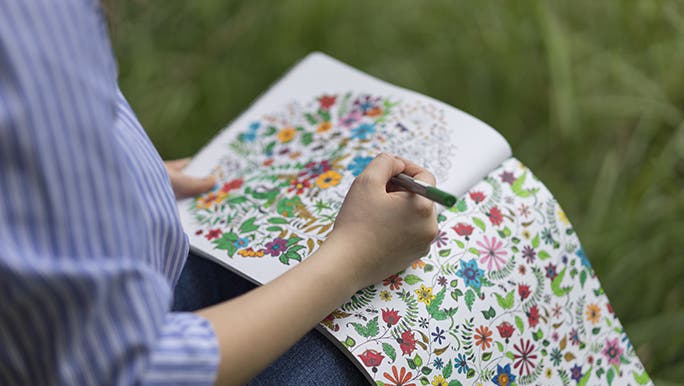
One study showed that mindful colouring might help to reduce symptoms of anxiety and stress, and improve vision and motor skills.
Creating your own colourful life
There are all sorts of ways to practise being mindful, and finding the right one for you could have many benefits. For example, sitting down with a mindfulness colouring book could be a better way to relax and unwind than opening a bottle of wine, especially if you’re cutting back on alcohol.
If you still struggle with stress-induced brain fog or anxiety, reach out to your GP, who’ll be able to refer you to an appropriate professional.
Related:
- Superfoods for brain clarity
- What is a life coach, and do I need one?
- Can’t get motivated to do all the things? Try these 10 tips
Dr Bec Jackson is a Consultant Psychologist with 20 years’ experience across clinical psychology, academia, therapy and education in clinical, forensic and organisational psychology.
Reviewed by the healthylife Advisory Board August 2021.
Related reads

What is mindfulness and how do I get started?
We live in a busy world, so it’s no surprise that interest in mindfulness is growing. This practice has been said to have benefits for everyone – adults, teens, kids and even athletes.


Why is self-care important?
Self-care isn’t self indulgent or selfish. But what is self-care and why is it so important?

How to get rid of brain fog and get back on your game
Understand why you can get brain fog and how to handle it with expert advice from psychologist, Dr Bronwyn Coward.

5-minute self-care activities for days when you just can’t even
Self-care doesn’t need to involve a grand plan to visit a health retreat. Even five minutes may make a difference.

Positive affirmations for an anxious mind
Looking for some ideas for your daily positive affirmation practice? Here’s Dr Bec’s personal routine to help with mild anxiety.

Affirmations for kids: helpful or harmful?
Affirmations for kids may be beneficial when introduced with care. We spoke with Health Psychologist Moira Junge about the do’s and don’ts.

Overcoming adversity: how to cruise through life's challenges
Overcoming adversity is an important life skill. We asked Consultant Psychologist Dr Bec Jackson to give us some practical tips. Here’s what she said…

Mindfulness Mondays: get your week off to a great start
You’ve heard of Meatless Mondays. Now there’s a new wellness practice entering workplaces: Mindful Mondays.

What exactly is a ‘healthy’ work-life balance?
Dr Bronwyn Coward provides expert advice on what a healthy work-life balance is and how to make it happen in your life.
This article is for informational purposes only and does not provide medical advice, diagnosis, or treatment. Any information published on this website or by this brand is not intended as a substitute for medical advice. If you have any concerns or questions about your health you should consult with a health professional.